Project Overview
“ The Kapuk Coastal Club Anchored on the Java Sea coastline within Pantai Indah Kapuk”
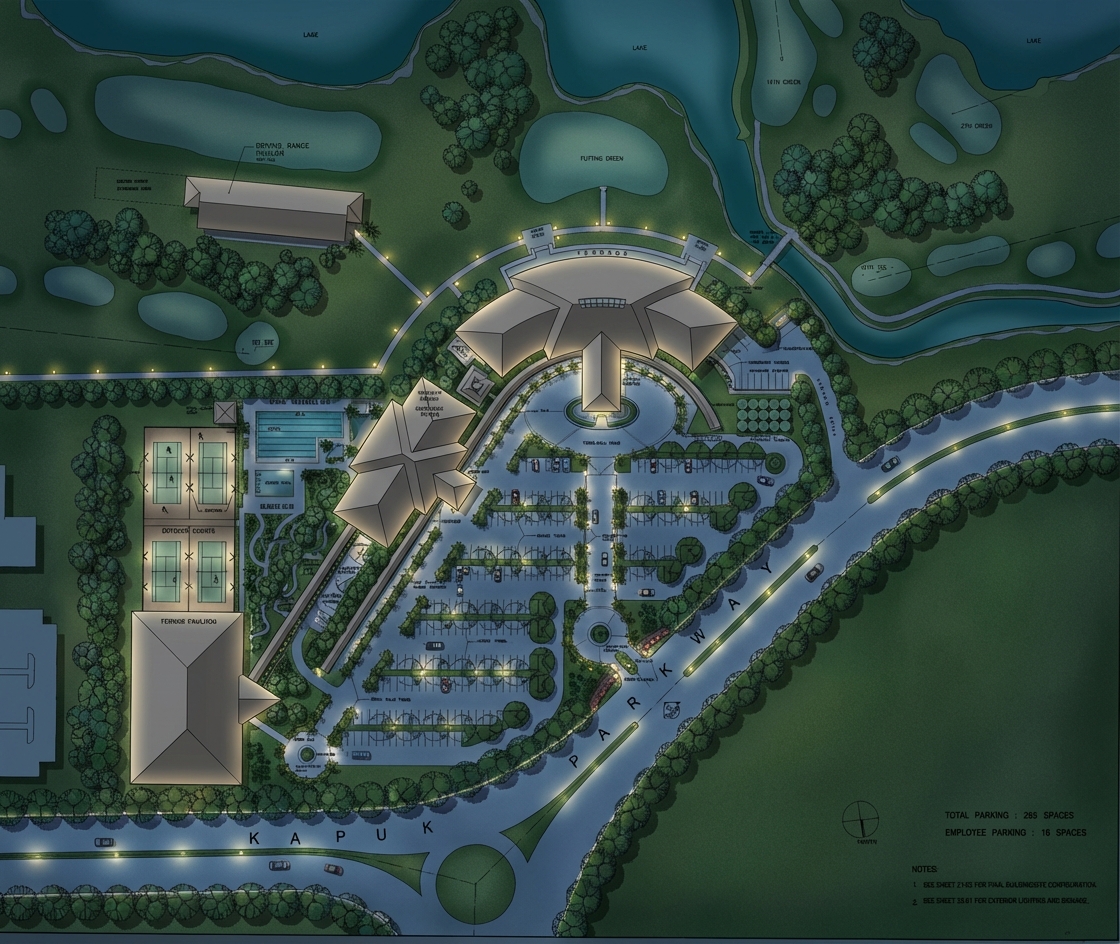
The Kapuk Golf & Recreation Center—anchored along the Java Sea coastline in Pantai Indah Kapuk (PIK)—is a coastal leisure destination that unites landscape, sport, and hospitality into a cohesive recreational campus. I was directly involved in this project during my time at DDG, where the initial conceptual framework and master plan were first established in an earlier design format. Although the project’s original iteration predated my tenure, I undertook a comprehensive revisiting of the design, refining its architectural language, updating its visual and experiential identity, and aligning the concept with contemporary performance, aesthetic, and operational goals.
What began as a legacy concept evolved into a renewed architectural vision—one that ultimately contributed to the project’s successful completion. This process allowed me to honor the foundation of the original design while strengthening its relationship to the site, its programmatic clarity, and its architectural presence along the shoreline.
Situated along a dramatic coastal edge, the Kapuk Golf & Recreation Center embraces “The Spirit of the Sea,” a guiding principle that shapes both its landscape movement and architectural form. The 72-par, 6,048-meter course integrates winding streams, indigenous fieldstone walls, and a sequence of lakes and water hazards that create a visually rich and strategic playing experience. As Jakarta’s only fully lighted 9-hole night-golf facility, the project enhances community use by extending the recreational environment well into the evening, creating a unique nighttime landscape of activity and illumination.
Tropical Comfort & Monsoon Logic drove the architectural approach. Deep overhangs, wide verandas, shading structures, and strategically oriented building forms promote natural cooling and circulation of sea breezes. The radial geometry of the clubhouse, shaped around the putting greens and primary view corridors, enhances shade distribution while creating a visually iconic form at the heart of the site. The clubhouse’s material palette—fieldstone, corrosion-resistant metals, and warm wood accents—reinforces regional identity while providing a durable response to coastal climate conditions.
Landscape & Site Strategy
Revisiting this project was both a technical and personal milestone. By modernizing the design, strengthening its narrative, and refining its architectural coherence, I had the opportunity to help carry the project from early concept to successful built reality, contributing to a coastal destination that continues to serve both recreational users and the broader PIK community. This project remains a meaningful reflection of my design values—deep respect for landscape, a commitment to place-based architecture, and the belief that strong ideas can evolve into enduring, built environments when given the opportunity.